Welcome! I’m Marie Comuzzo, a musicologist, environmental activist, and multimedia artist and performer.
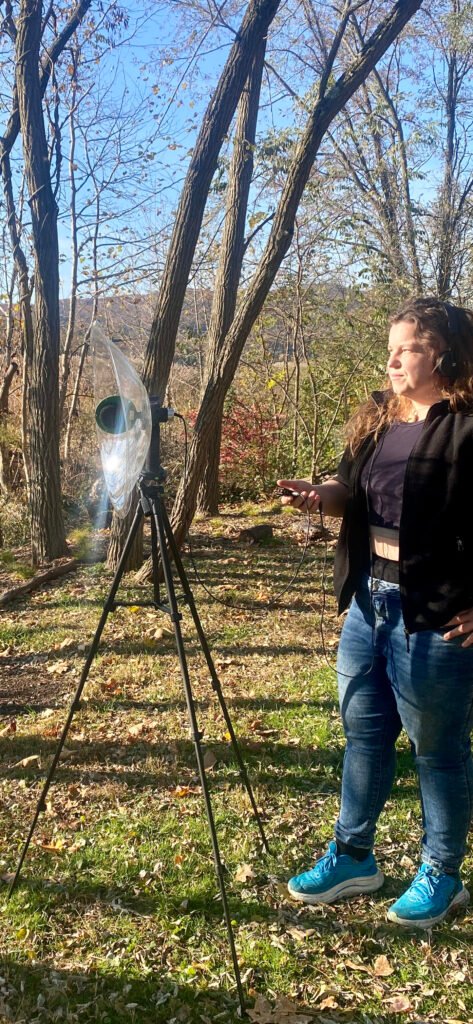
Doing field recordings with David Rothenberg and a team of more-than-human listeners in the Hudson Valley.
In my dissertation, I ask: how does sound mediate the relationship between humans and whales? And how does musicians’ listening with whales contribute to environmental advocacy?
With the support of an ACLS/Mellon Dissertation Innovation Fellowship I brought together a wide community of thinkers, changemakers, and artists through Listening with Whales, a public-facing digital commons that brings many different ways of listening into conversation. Listening with rather than to is at the center of the project: a way of listening that moves beyond the objectification of more-than-humans as objects from which we extract knowledge, centering instead the moral obligations emerging from listening with them.
As I listened with those participating in and creating sonic rituals of grief, I encountered:
- Musical portrayals of whale isolation and plight in the aftermath of the decimation of whale populations through commercial whaling, asking the listener to embody the whale;
- Mother whales’ grief over the loss of calves unable to survive in polluted environments;
- The collective mourning of dying pods in the aftermath of a stranding (which is often accompanied by a sustained attempt to reach members of the family through vocalizations in air);
- The experience a whale might have as she is engulfed by anthropogenic noise and is unable to communicate with her kin. These encounters repeatedly extended into the realm of the sacred.
Thus, my question has become: how do sonic gift exchanges sustain, mediate, and establish sacred kinships of mutual care, and what obligations emerge for humans from these relations?
Doing field recordings with David Rothenberg and a team of more-than-human listeners in the Hudson Valley.
- Musical portrayals of whale isolation and plight in the aftermath of the decimation of whale populations through commercial whaling, asking the listener to embody the whale;
- Mother whales’ grief over the loss of calves unable to survive in polluted environments;
- The collective mourning of dying pods in the aftermath of a stranding (which is often accompanied by a sustained attempt to reach members of the family through vocalizations in air);
- The experience a whale might have as she is engulfed by anthropogenic noise and is unable to communicate with her kin. These encounters repeatedly extended into the realm of the sacred.
For a quick overview of my research and the digital commons we are co-creating, check out “Listening With Whales: Song, Grief, and Obligations Across Ways of Knowing,” published by Platypus (CASTAC’s blog), for scholarly publications click here.
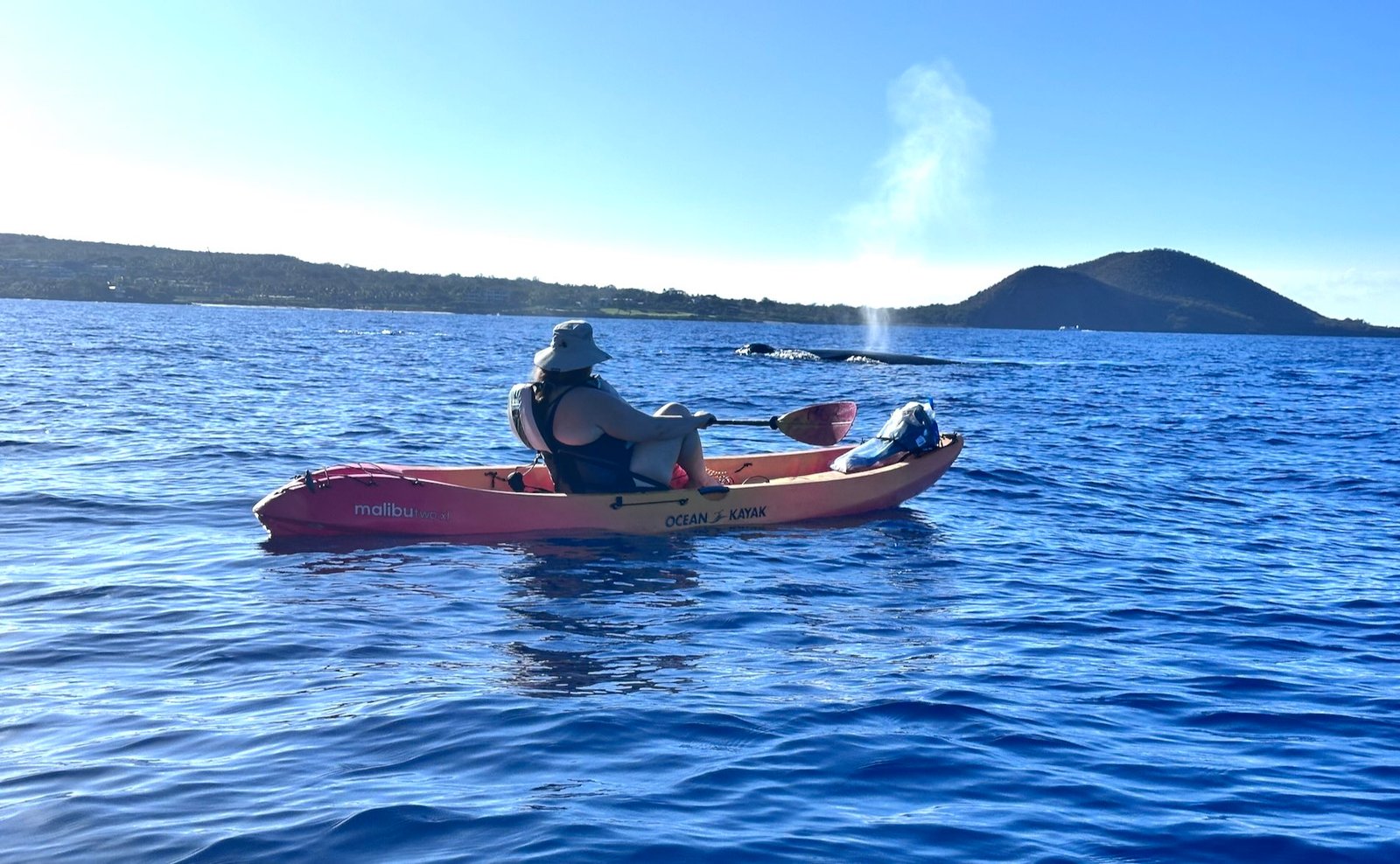
Doing field recordings with humpbacks in Maui. December 2024.
Building on queer, feminist, and decolonial musicological critiques, my work on fatphobia examines its discriminatory role in shaping the lives of early-career female and genderqueer instrumentalist in the United States. For this project, I rely on both historical and archival research, as well as on ethnographic interviews. I show how centering the lived experiences of those who are marginalized because of their body size is about challenging some of the foundational assumptions that sustain Western classical music’s exclusionary traditions. As musicology continues to grapple with questions of gender, race, trauma, and disability, I argue that the inclusion of fat studies offers an important and largely unexplored critical framework to uncover the intersectionality of exclusionary practices rooted in the body.
Earlier on, I conducted research on the unmusicking of women in parallel with the witch-hunts in Europe and their later exclusion from the musical canon. Arguing against the traditional teleological narrative of progress, and situating these histories within a feminist-Marxist analysis of reproductive labor and necropolitics in the aftermath of the Black Death Pandemic, I highlight a specific kind of silencing that doesn’t erase a person’s virtuosity and her ability to attract the admiration of the countless, but it establishes a woman’s expression and respectability as something always mediated through a patriarchal and an increasingly misogynistic gaze. This research deeply informs my work on the musicking of whales and the undoing of harmful epistemologies that establish hegemonic, gendered, racist, and speciesist ways of defining who has a voice worth listening to and with.
To address some of the issues in the classroom, I recently co-authored a digital humanities pedagogical article titled, “A Collaborative Timeline: Fostering Student Agency in the Music History Survey,” which asks, How do we teach a music history survey in a way that balances addressing canonical works with exploring historically excluded repertoire? How do we undertake such a task without expending all our fleeting time and resources? We share our experiences with TimelineJS, a multimedia digital-humanities tool we have successfully used in music history survey courses, and we offer a dialogic, interactive, imperfect yet expansive use of a digital-humanities tool to bring more student agency to the music history survey.
I am an active member of several societies, in music, marine science, and environmental studies. I serve as Website Manager for the Ecocriticism Study Group, and Brandeis University Press, as Student Board Member of the Journal of Musicology Pedagogy at the American Musicological Society, and as a member of the Indigenous+ Representation Subcommittee at the Society for Marine Mammalogy. As 2026, I am a also a content editor at Environmental History Now.
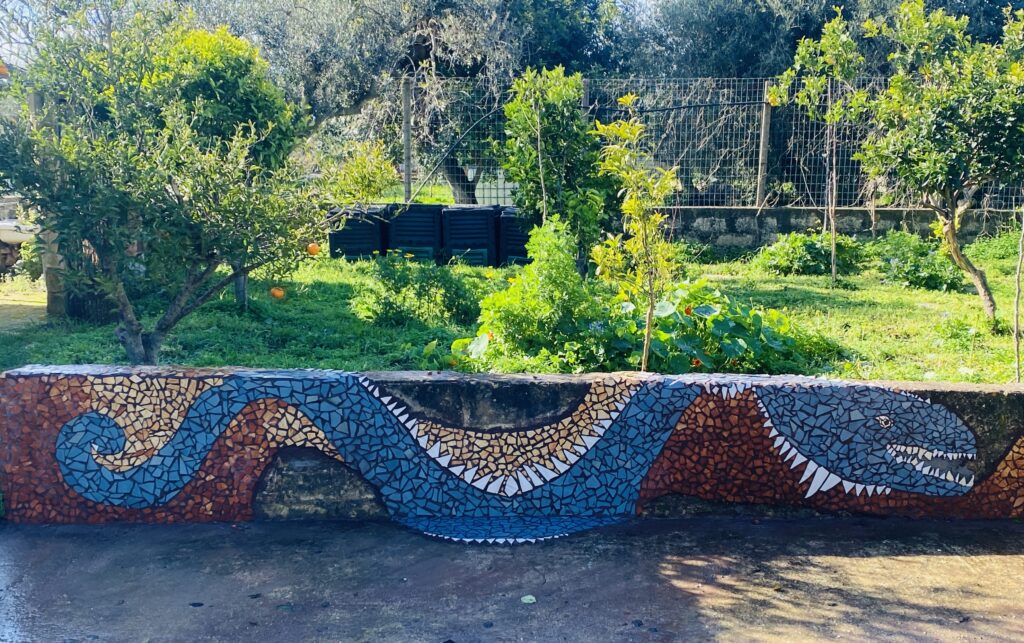
Below, a mosaic I made in 2025, watching over our fruit orchard, in Scicli (RG), Italy, inspired by my work at the Kinney Center for Interdisciplinary Studies, where I explored the relationship between ocean monsters and whale taxonomy in medieval times. I wrote some of my reflections in a blog post for the Renaissance of the Earth titled “How Kētos became Whale: Oceanic Cosmologies in Sky and Sea.”
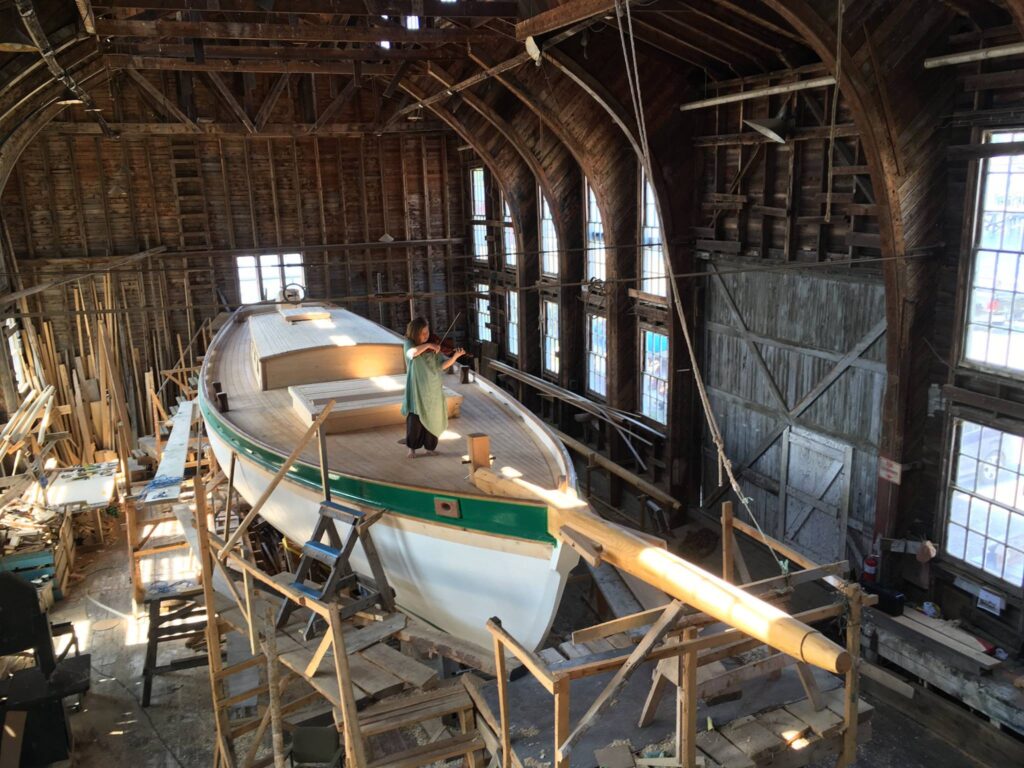
Before pursuing an academic career, I performed as a violinist, and studied in Italy at the Conservatorio Arrigo Boito in Parma and at Boston Conservatory at Berklee.
Navigate to: